






Rodion Tolmachev

Rodion Tolmachev, a bassoonist of the Mariinsky Theatre (an orchestra artist of the Fagot group) since 2004.
Saint-Petersburg Conservatoire graduate (class of Professor K. Sokolov), he joined the Orchestra of the Mariinsky Theatre at his student days. In 2004, he continued his education at the High Musical School of Hannover, Germany, in Professor Yensen’s master classes. In 2007, Rodion took post-graduate courses both in the Saint-Petersburg Conservatoire and the High Musical School of Hannover.
Even as a student of the Saint-Petersburg Conservatoire he won in the “Gartow Stiftung “ International German Charity Foundation Competition and the “Yamaha” Contest. In 2001 Rodion became the Laureate of the European Cultural Foundation .
His background includes a great number of honorary awards and prizes, among them the 1st prize in the Republic Wind Instruments Competition, Tashkent, 1995; the 1st prize in the “Shore of Hope” Contest, Albena, Bulgaria, 1998; the 1st prize in the Rimsky-Korsakov Wind Instruments All-Russian Competition, Saint-Petersburg, 2000; the 3rd prize in the ARD International Quintet Contest, Munich, Germany, 2001; the Grand Prize in the JDR International Wind Instruments Competition, Tokyo, Japan, 2007; the 1st prize in the International Fagot Contest, Provo, Utah, USA, 2008.
Rodion Tolmachev has extensively toured as a soloist with the Mariinsky Orchestra and others Saint-Petersburg ensembles. He often plays on tour with the Woodwind Quintet of Mariinsky Theatre.
In 2007 and 2008 he performed with the Hermitage Theatre Orchestra in the “Musical Olympus” Festival, Saint-Petersburg.
Since 2010 Rodion is an invitee soloist of the United World Orchestra, conductor Valery Gergiev.
In 2012, “Dobringenund Grimm” recorded a solo album of Rodion Tolmachev, namely fagot masterpieces of French composes.
In 2016, Rodion Tolmachev released a solo disc with the Mariinsky Theater Orchestra conducted by Ivan Stolbov, with concerts for bassoon by Antonio Vivaldi, Carl Maria von Weber and Andre Jolivet

Ruslan Mamedov, a bassoonist of the Mariinsky Theatre (an orchestra artist of the Fagot group)
Graduated from the Musical college and the Volgograd Conservatoire named after P. Serebryakov , class of Associate Professor, People's Artist of Russia A. Sokirko. Continued his post-graduate studies in the Saint-Petersburg Conservatoire, class of Professor, People's Artist of Russia K. Sokolov.
Ruslan Mamedov is the winner of the award of the South Russia Competition, Rostov-on-Don, and the Rimsky-Korsakov International Competition, Saint-Petersburg. In 2000, he joined the Volgograd Academic Symphony Orchestra. In 2008 became a soloist- regulator of the Mariinsky Theatre.
His timbre specifies the sound of woodwinds and the whole orchestra. The artist masters the whole range and expressiveness of fagot. His repertoire embraces, along with classical productions like “Ruslan and Lyudmila” by M. Glinka or “Pskovityanka” by N. Rimsky-Korsakov - his solo is in concord with the music of XX century, specifically in “Holy Spring” by I. Stravinsky, “Dead Souls” by R. Schedrin. Acting as an orchestra artist Ruslan performs in chamber music concerts. Thus, in May 2014 his quintet offered a programme varied from J. Haydn to Nino Rota.
In addition to classical fagot Ruslan also masters contra-fagotto. In 2014 he performed Gran Partita by Mozart in the Concert Hall of Mariinsky Theatre. His performances were a tremendous success in the Small Hall of Saint-Petersburg Conservatoire during the “International Conservatoire Week” Festival, the Saint-Petersburg House of Music, the Grand Hall of Moscow Conservatoire. In April 2016, in the Mariinsky Concert Hall he performed Concert by Henri Tomasi - one of the most complicated fagot solo.
As an orchestra artist he took part in first nights of Mariinsky Theatre, audio and video recordings of “Mariinsky” label (all symphonies by Tchaikovsky, Shostakovich, symphonies and concerts by Prokofiev, opera and ballet productions).
RUSLAN MAMEDOV


Andrey Shamidanov – a soloist of the Russian National Orchestra. As an invitee orchestra artist performs with the Moscow chamber orchestra “Musica Viva”.
Graduated from the Moscow Conservatoire named after Tchaikovsky (class of People's Artist of Russia, Professor V. Popov). Attended master classes of Professor Klaus Thunemann, as well as the soloist and master of the Munich Philarmonia Lyndon Wadss.
Andrey is the Winner of the International Competitions in Athens, Volgograd, Lvov, Moscow; he won the 1st prize in the First Rimsky-Korsakov International Competition, Saint-Petersburg; he is also the laureate in the Fourth International Competition of Wind and Percussion Instruments, the Moscow Conservatoire, 2014.
Andrey Shamidanov performed with many prominent Russian and European orchestras directed by M. Pletnev, K. Nagano, T. Currentzis, A. Rudin,Y. Bashmet, V. Jurowski, A. Lazarev, A. Vedernikov, V. Petrenko, A. Gilbert, P. Summers, N. Luizotti, Sir R. Norrigton, P. Jarvy, A. Zedda, Ch. Moulds, etc.
As a fagot soloist of the Russian National Orchestra (conductor M. Pletnev) he recorded The Nine symphonies by Beethoven (Deutsche Grammophon label).
Andrey Shamidanov has undertaken many tours. He participated in numerous international and Russian festivals. Within the Project of Russian-German Academy he took part in the Easter Festival of 2016

Andrey Shamidanov








Geoffrey Hartley:Round the Mulberry Bush In E-Flat Major

THE TREASURES OF BASSON KINGDOM
Magnificent Russian ensemble of bassoonists of the Mariinsky Theatre and the Russian National Theatre is glad to present original compositions for fagot trio of multiethnic sources.
They begin with the Trio, Op. 17 by French composer, critic and musical expert François-Henri-Joseph Blaze (1784 – 1857). When a boy he learned music from his father, lawyer and composer A. Blaze, and continued his studies in the Conservatoire de Paris.
Since 1820 as a music critic he published Musical Chronicles in the Journal des débats and La France musicale (1837). Among his manuscripts on the history of French and European music quite a special place occupied the works dedicated to the art of opera and ballet. He translated to French and adapted the opera librettos by J. Rossini, G. Donizetti, V. Mozart, K. Weber.
He composed three operas, masses, chorus and chamber instrumental music. His Trio for bassoons, Op. 17 is notable for impeccability of style, vivid manner and clarity of technical mastery.
Our journey to the world of chamber music will be continued with the Suite by German composer and bassoonist Christian Julius Weissenborn (1837 – 1888). He is famous for the best in the world Practical Bassoon School. Being the principal bassoonist of the famous
Leipzig Gewandhaus Orchestra, he also taught at the Leipzig Conservatoire.Julius Weissenborn created a lot of original compositions for fagot and piano, as well as several remarkable trios. Dance Suite in six pieces is a real gem among them – entrancing Serenade is followed by antagonistic Polonaise to contrast with graceful Polka and sparkling scherzo Mazurka. Two rich in contrast Turkish and Funeral Marches finalize the composition.
Music by British composer and bassoonist Jeffrey Hartley (1906-1992) Round the Mulberry bush – arrangement of the English nursery rhyme and song – will bring the album to a close.
A native of Oxford, Hartley started to master fagot at school at the age of 16. He used an antique instrument from his father’s collection.
In 1948, he organized The Occasional Wind Players, they gave hundreds concerts in London and environs. Hartley was the first bassoonist in the Chelsea Opera House under the direction of Sir Colin Davis. Alongside with extensive concert activity he composed a lot of chamber music including several fagot compositions. Outstanding power of music escorted him within the whole life.
They begin with the Trio, Op. 17 by French composer, critic and musical expert François-Henri-Joseph Blaze (1784 – 1857). When a boy he learned music from his father, lawyer and composer A. Blaze, and continued his studies in the Conservatoire de Paris.
Since 1820 as a music critic he published Musical Chronicles in the Journal des débats and La France musicale (1837). Among his manuscripts on the history of French and European music quite a special place occupied the works dedicated to the art of opera and ballet. He translated to French and adapted the opera librettos by J. Rossini, G. Donizetti, V. Mozart, K. Weber.
He composed three operas, masses, chorus and chamber instrumental music. His Trio for bassoons, Op. 17 is notable for impeccability of style, vivid manner and clarity of technical mastery.
Our journey to the world of chamber music will be continued with the Suite by German composer and bassoonist Christian Julius Weissenborn (1837 – 1888). He is famous for the best in the world Practical Bassoon School. Being the principal bassoonist of the famous
Leipzig Gewandhaus Orchestra, he also taught at the Leipzig Conservatoire.Julius Weissenborn created a lot of original compositions for fagot and piano, as well as several remarkable trios. Dance Suite in six pieces is a real gem among them – entrancing Serenade is followed by antagonistic Polonaise to contrast with graceful Polka and sparkling scherzo Mazurka. Two rich in contrast Turkish and Funeral Marches finalize the composition.
Music by British composer and bassoonist Jeffrey Hartley (1906-1992) Round the Mulberry bush – arrangement of the English nursery rhyme and song – will bring the album to a close.
A native of Oxford, Hartley started to master fagot at school at the age of 16. He used an antique instrument from his father’s collection.
In 1948, he organized The Occasional Wind Players, they gave hundreds concerts in London and environs. Hartley was the first bassoonist in the Chelsea Opera House under the direction of Sir Colin Davis. Alongside with extensive concert activity he composed a lot of chamber music including several fagot compositions. Outstanding power of music escorted him within the whole life.
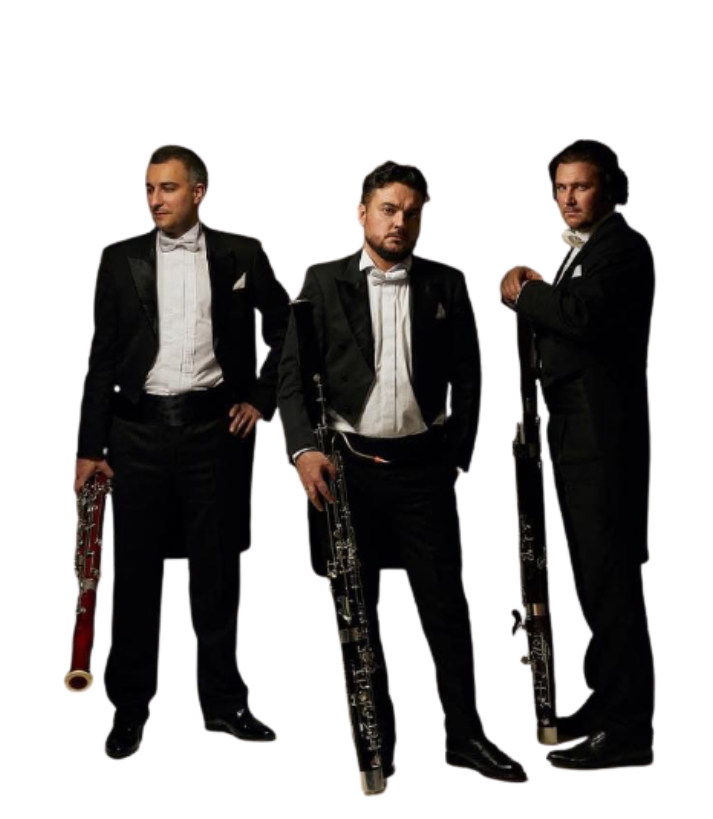
A new album by the trio of Russian bassoonists Rodion Tolmachev, Ruslan Mamedov, Andrey Shamidanov of the Mariinsky Theatre Orchestra and the Russian National Orchestra represents rare compositions from different national schools of the 20th century.
The album is opened with The Witches Frolic (also known as The Three Witches of the Night) by the British composer and conductor Sir Granville Bantock (1868-1946), the very fragment from a suite for bassoon trio was created in 1926 for the theatrical production of Shakespeare's Macbeth. The music is distinguished by ingenuity and contrasting moods, that way unleashing the creative potential and virtuoso possibilities of the musicians. Bantock was a professor of music at the University of Birmingham and director of the local Conservatoire. It was him who was at the origin of the famous Birmingham Symphony Orchestra.
Continuing the British musical tradition of the 20th century, the CD features a suite of diverse folk dances by Geoffrey Hartley (1906-1992). The syncopated rhythm of the Scottish Hornpipe dance is followed by a romantic waltz and a lively march. A native of Oxford, Hartley learned to play fagot when a child, practicing an antique instrument from his father's collection. He gave more than a hundred concerts in London and its outskirts. Hartley was concertmaster of the bassoon group at the Chelsea Opera House under the direction of renowned Sir Colin Davis.
The work of the outstanding Danish composer Carl Nielsen (1865-1931), who mastered different genres, is represented by rare miniatures for the bassoons – three pieces, Op. 11: the eccentric Doll’s March, the whimsical Dance of the Lady’s Maids, and the sarcastic Jumping Jack. Nielsen's music is distinguished by its ingenuity, Nordic character, and developed polyphony. Karl Nielsen is an undoubted founder of the modern Danish school of composition. His symphonies, chamber and vocal pieces represent a reference example for this genre of the 20th century.
Another masterpiece by Geoffrey Hartley - "Jack and Jill" Trio for three bassoons - was inspired by the English folk nursery rhyme from "The Tales of Mother Goose".
The album is topped up with music by the German composer and bassoonist Viktor Bruns (1904-1996). Viktor was born into a German family on August 15, 1904, in a small town of Ollila (southeastern Finland) where his parents spent summer. They lived in St. Petersburg, so Viktor studied at the Petrograd State Conservatoire (later the Leningrad State Conservatoire) at the bassoon class of Alexander Vasiliev from 1924 to 1927, and the composition class of Vladimir Shcherbakov from 1927 to 1931. From 1927 to 1938 Viktor Bruns was a bassoonist of the Kirov Opera and Ballet Theatre Orchestra (nowadays Mariinsky Theatre). Among the vast composing heritage for wind instruments a special place is occupied by the Trio (for tenor bassoon, bassoon, and contrabassoon), Op. 97. This is one of his later works dedicated to the English bassoonist and musicologist William Waterhouse (February 18, 1931 - November 5, 2007), who played with famous orchestras, was a member of the Melos ensemble and a professor at the Royal Northern College of Music.
The four parts of the Trio are notable for contrasting drama, vivid imagery, and distinctive rhythmic patterns. Bruns used to say that "musicians always want something melodic, just to be rhythmic and interesting." He indeed tried to please them. The composer passed away in 1996 before his last work, the Octet for Bassoons, Op. 99, was completed. Only a fragment of this masterpiece remains. Here’s why the great attention is paid to his previous major work - the Trio, Op. 97, presented in this album
The album is opened with The Witches Frolic (also known as The Three Witches of the Night) by the British composer and conductor Sir Granville Bantock (1868-1946), the very fragment from a suite for bassoon trio was created in 1926 for the theatrical production of Shakespeare's Macbeth. The music is distinguished by ingenuity and contrasting moods, that way unleashing the creative potential and virtuoso possibilities of the musicians. Bantock was a professor of music at the University of Birmingham and director of the local Conservatoire. It was him who was at the origin of the famous Birmingham Symphony Orchestra.
Continuing the British musical tradition of the 20th century, the CD features a suite of diverse folk dances by Geoffrey Hartley (1906-1992). The syncopated rhythm of the Scottish Hornpipe dance is followed by a romantic waltz and a lively march. A native of Oxford, Hartley learned to play fagot when a child, practicing an antique instrument from his father's collection. He gave more than a hundred concerts in London and its outskirts. Hartley was concertmaster of the bassoon group at the Chelsea Opera House under the direction of renowned Sir Colin Davis.
The work of the outstanding Danish composer Carl Nielsen (1865-1931), who mastered different genres, is represented by rare miniatures for the bassoons – three pieces, Op. 11: the eccentric Doll’s March, the whimsical Dance of the Lady’s Maids, and the sarcastic Jumping Jack. Nielsen's music is distinguished by its ingenuity, Nordic character, and developed polyphony. Karl Nielsen is an undoubted founder of the modern Danish school of composition. His symphonies, chamber and vocal pieces represent a reference example for this genre of the 20th century.
Another masterpiece by Geoffrey Hartley - "Jack and Jill" Trio for three bassoons - was inspired by the English folk nursery rhyme from "The Tales of Mother Goose".
The album is topped up with music by the German composer and bassoonist Viktor Bruns (1904-1996). Viktor was born into a German family on August 15, 1904, in a small town of Ollila (southeastern Finland) where his parents spent summer. They lived in St. Petersburg, so Viktor studied at the Petrograd State Conservatoire (later the Leningrad State Conservatoire) at the bassoon class of Alexander Vasiliev from 1924 to 1927, and the composition class of Vladimir Shcherbakov from 1927 to 1931. From 1927 to 1938 Viktor Bruns was a bassoonist of the Kirov Opera and Ballet Theatre Orchestra (nowadays Mariinsky Theatre). Among the vast composing heritage for wind instruments a special place is occupied by the Trio (for tenor bassoon, bassoon, and contrabassoon), Op. 97. This is one of his later works dedicated to the English bassoonist and musicologist William Waterhouse (February 18, 1931 - November 5, 2007), who played with famous orchestras, was a member of the Melos ensemble and a professor at the Royal Northern College of Music.
The four parts of the Trio are notable for contrasting drama, vivid imagery, and distinctive rhythmic patterns. Bruns used to say that "musicians always want something melodic, just to be rhythmic and interesting." He indeed tried to please them. The composer passed away in 1996 before his last work, the Octet for Bassoons, Op. 99, was completed. Only a fragment of this masterpiece remains. Here’s why the great attention is paid to his previous major work - the Trio, Op. 97, presented in this album
WIZARD & COMPOSERS OF XX CENTARY
The trio of Russian musicians, which includes Rodion Tolmachev, Ruslan Mamedov, Andrey Shamidanov, bassoonists of the Mariinsky Theater Orchestra and the Russian National Orchestra, includes rare works created by composers from different national schools and centuries.
If the player does not appear, reload the page
If the player does not appear, reload the page



Video coming soon